Sunday, 25 February 2018

LIMITED EDITION RENAULT KWID LAUNCHED IN SOUTH AFRICA


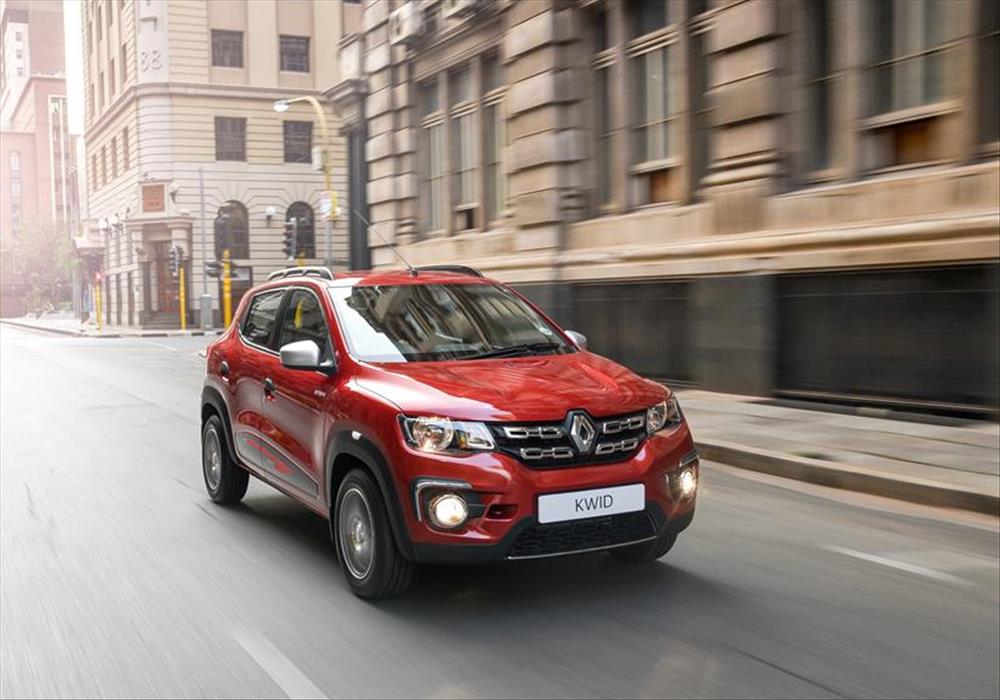
The Renault Kwid is now also available in a Limited Edition, the Kwid Xtreme, which boasts enhanced design by means of an exterior styling pack.
There are chrome exterior accents which include an insert for the front grille, fog lamp surrounds, front bumper garnish and a tailgate strip.
Apart from being aesthetically pleasing, the distinctive detailed bumper protectors are designed to protect the corners of the bumpers against scuffs and scrapes.
The SUV look is enhanced by black rails fitted on the roof and a set of black plastic mud flaps added to protect the body of the Kwid Xtreme against mud and water.
It is further distinguished by 14" rims and tyres plus funky bespoke decals.
The standard Kwid technology such as air conditioning, electric front windows and on-board navigation, is complemented by rear parking distance control to guide the driver into even the tightest of parking spots. Peace of mind is added by a Lock-On Drive system which automatically locks the doors at 20km, for added security.
The Kwid features bold exterior styling, with a high ground clearance of 180mm, that offers a high driving position and greater visibility, making it ideal for zipping around in urban traffic or cruising down the open highway. Its longer wheelbase, at 2 422mm, allows for a spacious cabin plus greater rear legroom. Boot space is a handy 300 litres.
At first glance, the boldly structured front grille design highlights Renault's diamond-shaped logo, while the vehicle's C-shaped headlights incorporate the brand's new lighting signature.
The Kwid's subtly sculpted sides provide a fluid, dynamic touch. The rectangular form of the black cladded and flared wheel arches is another pointer to its SUV breeding while also offering additional protection.
While the lower door decor underlines the Kwid's robust character, the forward-positioned windscreen and large windows ensure good visibility for the driver and play a big part in travelling comfort, while the sharp creases on the bonnet give it a muscular look.
At the rear, the lower part of the bumper comes with a black trim and the body-coloured tailgate spoiler adds to the car's dynamic stance.
The interior of the Kwid offers style and practicality, featuring intuitive technology to ensure that driver and passengers stay connected. This includes a MediaNav navigation and multi-media system complete with large 7" touch screen display, radio and Bluetooth connectivity housed in an attractive piano black centre console with chrome finishing.
The height-adjustable front seats are generously sized, offering superior comfort, while the electric power steering and one-touch lane change indicator make driving a breeze.
Electric front windows add to driver and front passenger convenience while the powerful air-conditioning with heater functionality ensures driving pleasure irrespective of the weather.
An open storage space faces the front passenger, with lower glove box plus upper glove box space. Both the driver and passenger have in-door storage space with a 1-litre bottle holder and rear parcel tray for practical and convenient stowage.
The Kwid model range is powered by a new 1,0 litre Smart Control efficiency (SCe) engine mated to a five speed manual gearbox that ensures smooth driving.

The interior of the Kwid offers style and practicality, featuring intuitive technology to ensure that driver and passengers stay connected.


If you are in the market for a Renault KWID - view Group 1 Renault’s available range here or visit a Group 1 Renault dealership and test drive the Renault KWID!

Wednesday, 31 January 2018

Renault Trafic automatic confirmed at last


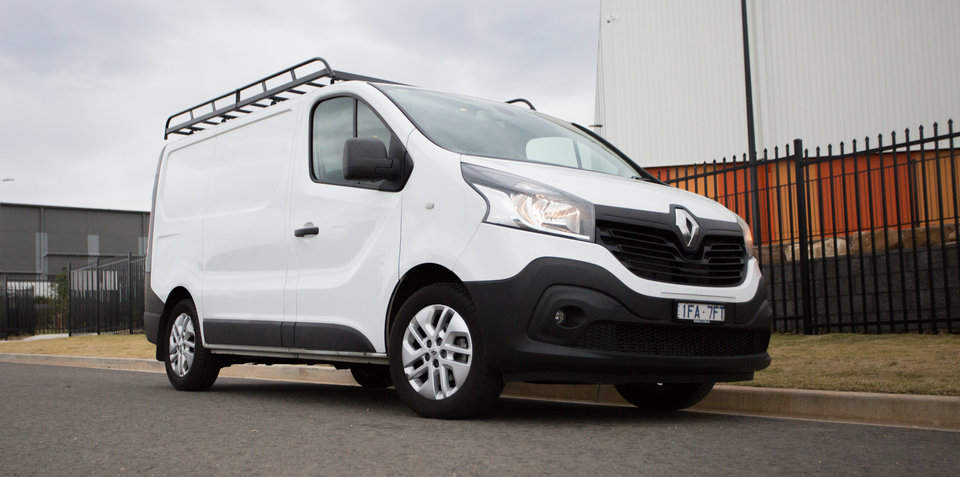
Better late than never. The Renault Trafic mid-sized van will get a much-needed automatic transmission in current-generation guise, the company has confirmed.
A firm timeline is not clear because it’s a bit of a moving feast internally, but Renault Australia light commercial line manager Lyndon Healey says the self-shifter has at least been green lit.
A time time frame of about 18 months from now has been mooted, however.
The automatic question has long been asked by Renault Australia, but given the company sells vastly more Trafics into manual-heavy markets such as France, it’s been a low R&D priority.

But with growing demand for autos in the big-volume UK market too, the decision has been made in Australia’s favour at last. The availability of an automatic is vital for Renault here to stop its market share stagnating.
It expects 50 per cent more direct Trafic sales, as well as greater retention of Master or Kangoo owners set on staying with a one-brand fleet once the auto comes on stream.
The automatic in question will be a reworked version of the dual-clutch semi-auto ‘box used in the Euro-market Talisman and Espace, and not a more conventional robotised manual as with the old model, and matched to the familiar 1.6-litre turbocharged diesel engines.
“We can say for certain we are getting an auto Trafic, but it’s hard to pin down an exact date,” Healey said, though confirming it’d be in the current car’s life cycle, which began in 2015 and will go well beyond 2020.

These comments prove the veracity of those given to us back in September 2015 by Renault’s global executive vice-president Jerome Stoll, who said: “Frankly I think we have to reconsider… the auto gearbox is becoming more and more a part of the life of everybody”.
The manual-only Trafic, alongside the Ford Transit, has been losing out to some rivals with automatics like the Toyota HiAce, Hyundai iLoad and Volkswagen Transporter. Autos are especially favoured by tradies in congested areas.
Not that Trafic sales are stalling — yet. It managed 1730 sales in 2016, giving it 8.6 per cent share. But an auto would, by the company’s projections, put it beyond the Transporter (1960 sales last year). The leaders are the HiAce (7478 in 20167) and iLoad (5467).
Renault is this week launching a six-seater Trafic crew van derivative. Expect a review on that car soon.
If the Renault Trafic has caught your attention - book a test drive at Group 1 Renault or view the Renault Trafic online for more specs and information.

Article source: http://www.caradvice.com.au/524715/renault-trafic-automatic-confirmed-at-last/

Monday, 8 January 2018

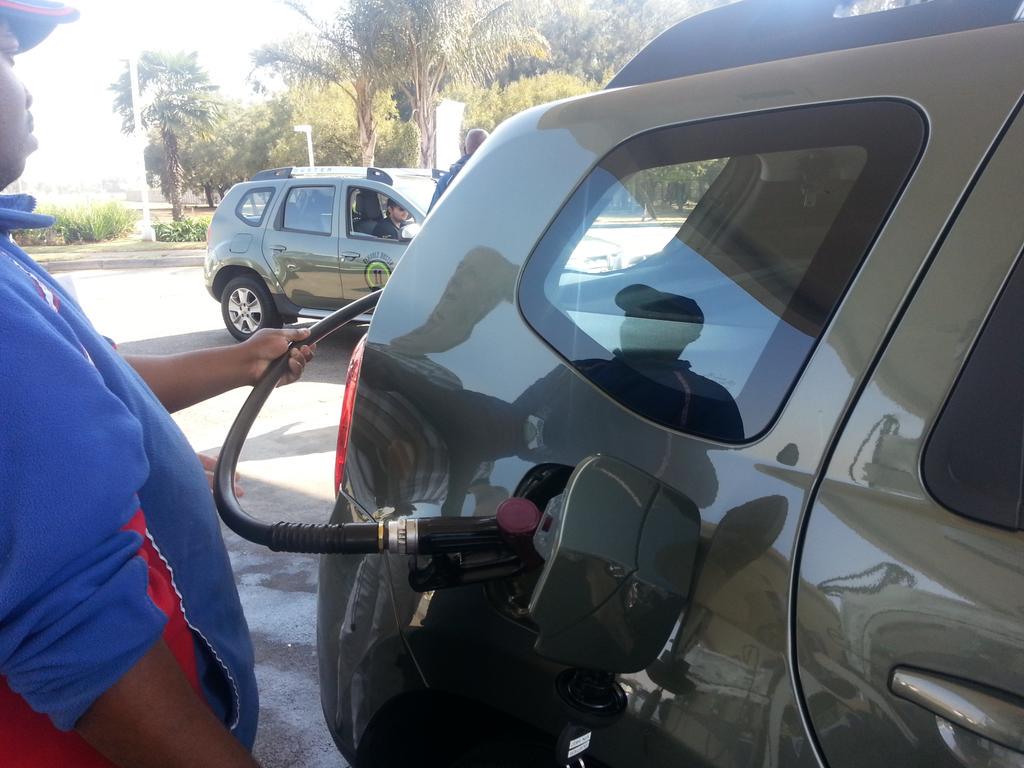
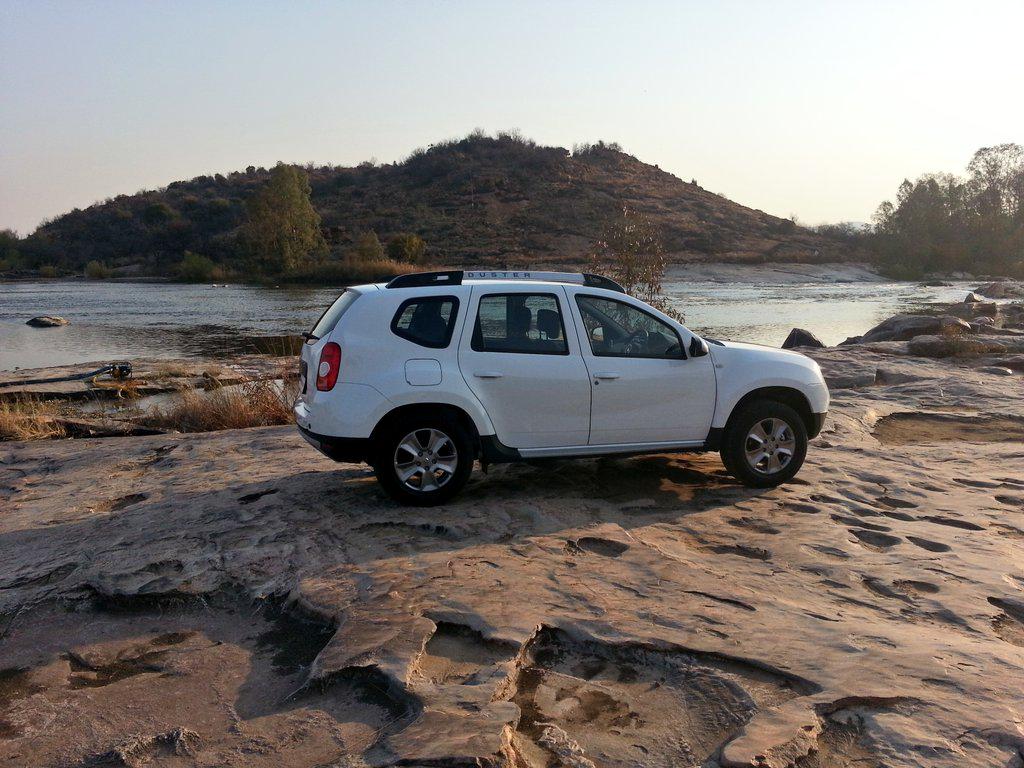
New Renault Duster in SA: Revamped, revitalised


WINNING FORMULA: Renault builds on the local success of it Duster with design and interior tweaks as well as revised diesel engine.

• More than 8000 units sold in SA
• New production factory in Romania  
• Revised diesel engine

• Revised exterior and interior

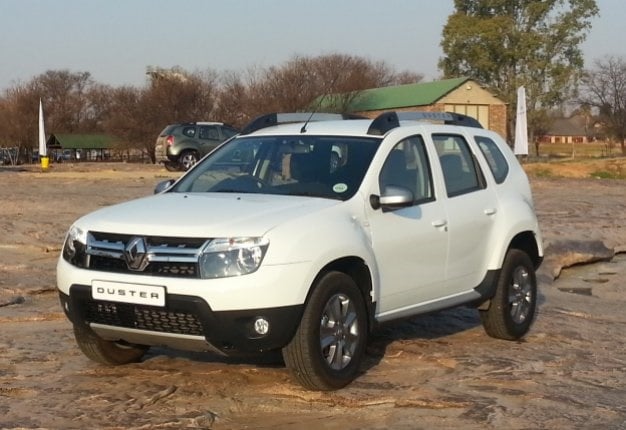
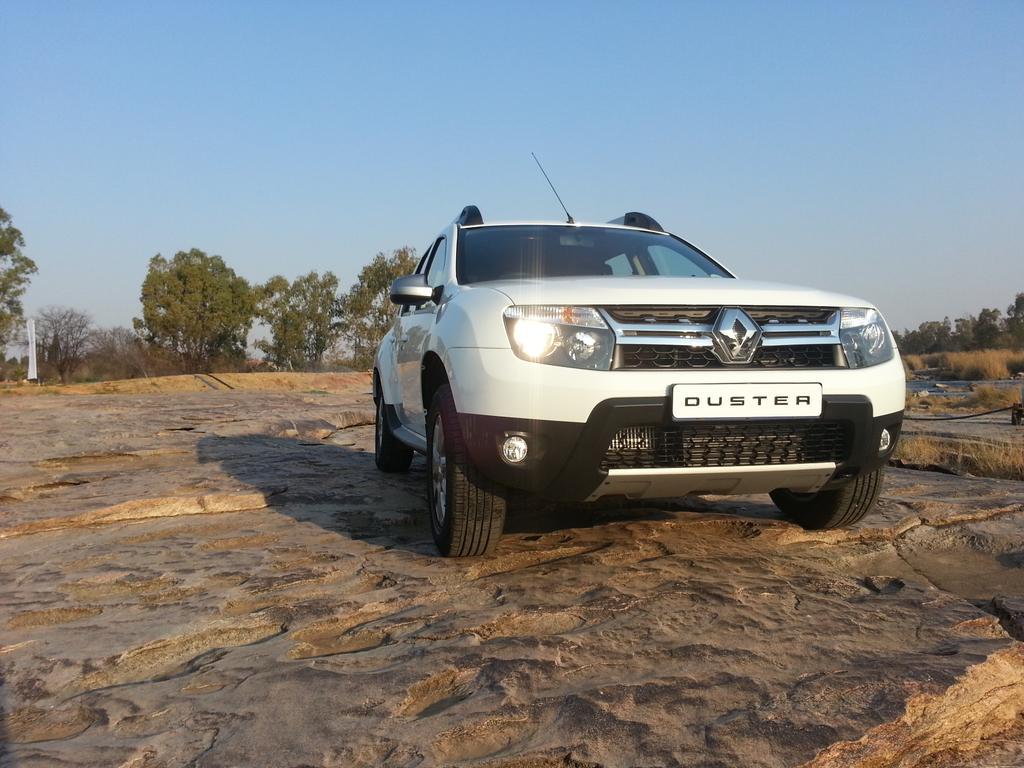
Revamped and revitalised, facelifted Renault Duster has arrived in South Africa. Enhanced inside and out, Renault builds on the local success of its Duster with refreshed styling, new features and improved turbo diesel.

LOCAL SUCCESS
Since its launch in 2013, Renault has sold more than 1.3-million globally and 8000 units locally.
According to Renault: "The first Renault model designed to meet stringent European standards - yet be capable of conquering international markets where usage and road conditions are considerably more rugged - two years down the track, Duster continues to be a formidable contender in South Africa’s B-SUV segment."
The Duster line-up remains unchanged; two specification levels (expression and dynamique), two engine options (petrol and diesel) and two variants (4x2 and 4x4)
The 1.6 normally aspirated petrol (Expression and Dynamique 4x2) is capable of 75kW/148Nm and is mated to a five-speed manual. Fuel consumption is rated at 7.6 litres/100km with emissions of 181g/km.
The 1.5 dCi turbo diesel engine (Dynamique 4x2 and 4x4 models) is capable of 80kW/240Nm. The revised diesel outperforms its predecessor in terms in terms of fuel efficiency, with a claimed consumption of 4.8 litres/100km (down from 5.5 litres/100km) with emissions of 127g/km (4x2) and 135g/km in 4x4 guise.

What's new
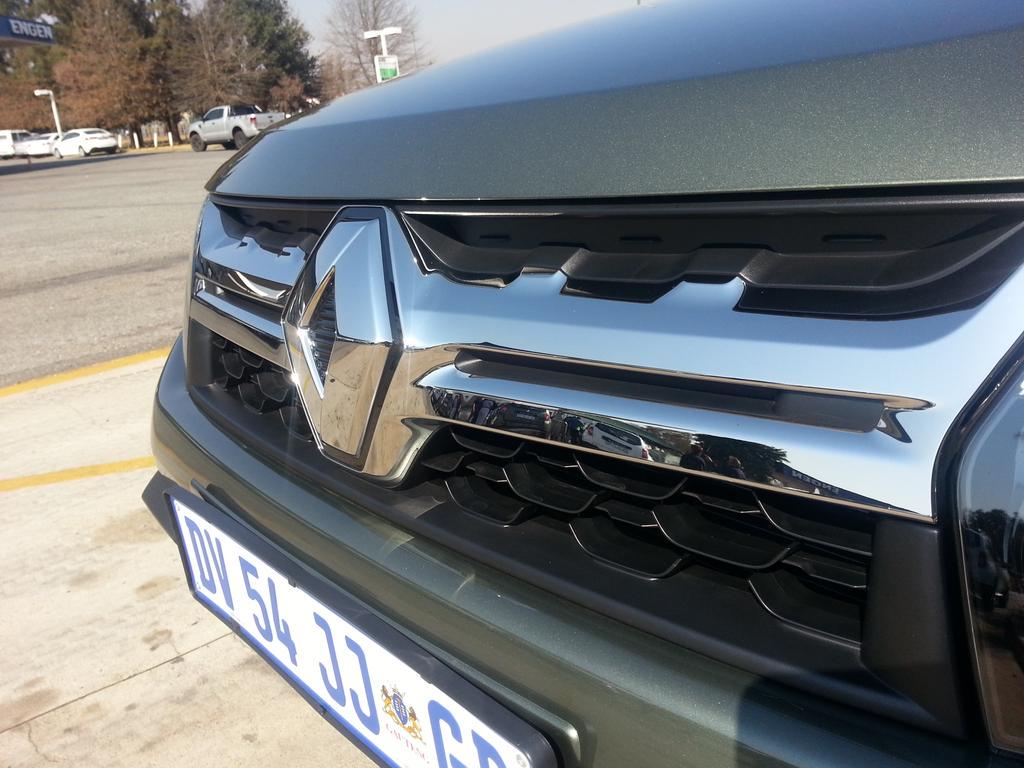
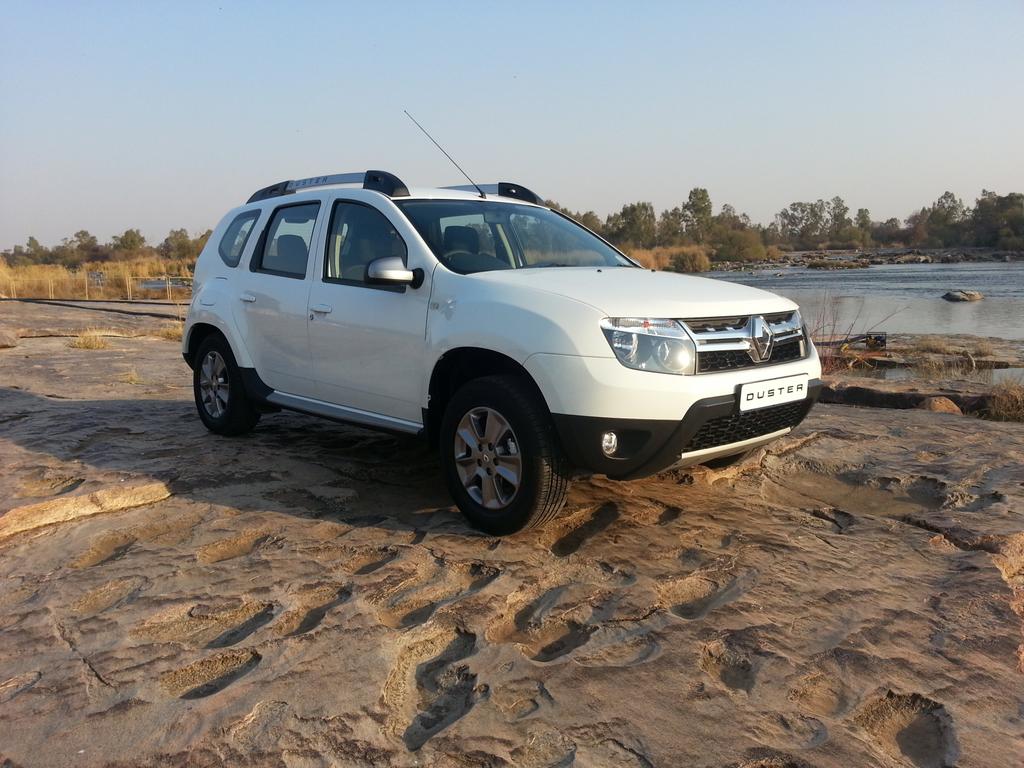
 • Two chromed horizontal grille strips (instead of three) and re-designed Renault diamond logo   
 • Less chromed trim at the front
 • New roof bars with Duster moniker etched into the aluminium insets.
 • Body coloured side-mirrors
 • New alloy rims.
 • Parking distance control (standard)
 • Patterned fabric replaces plain seat and door panel design.
 • 7” touchscreen satnav (Dynamique variants only)
 • Cruise control now standard
 • Leather trim and seat optional on all three derivatives

HOW FRUGAL IS IT?
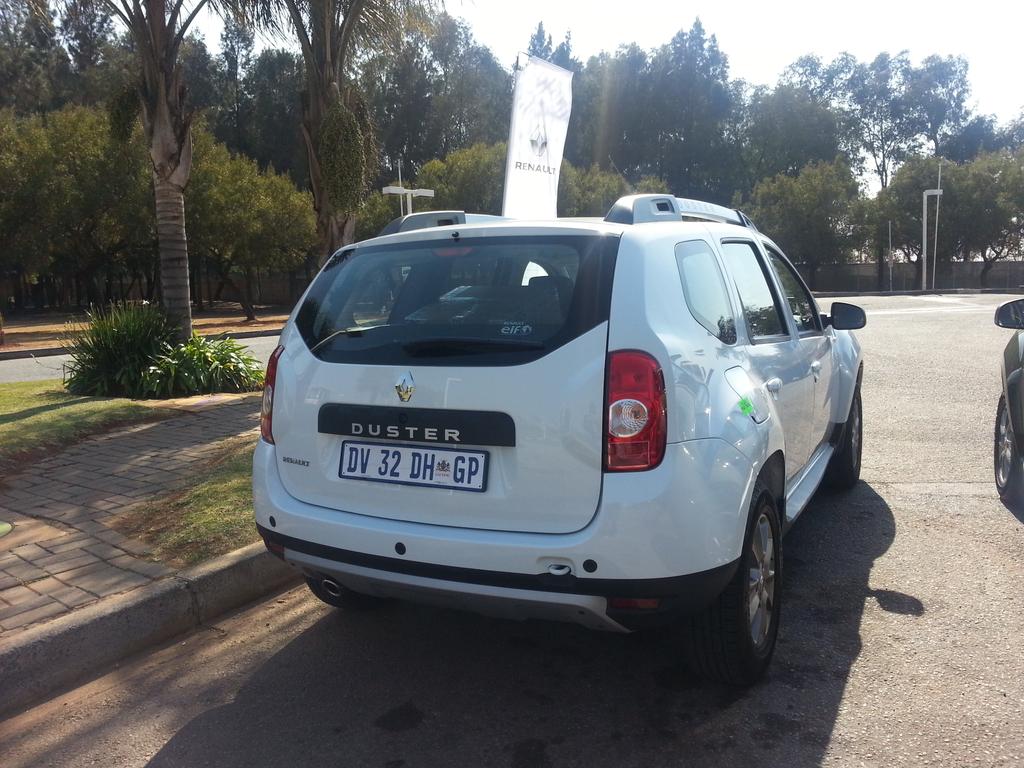
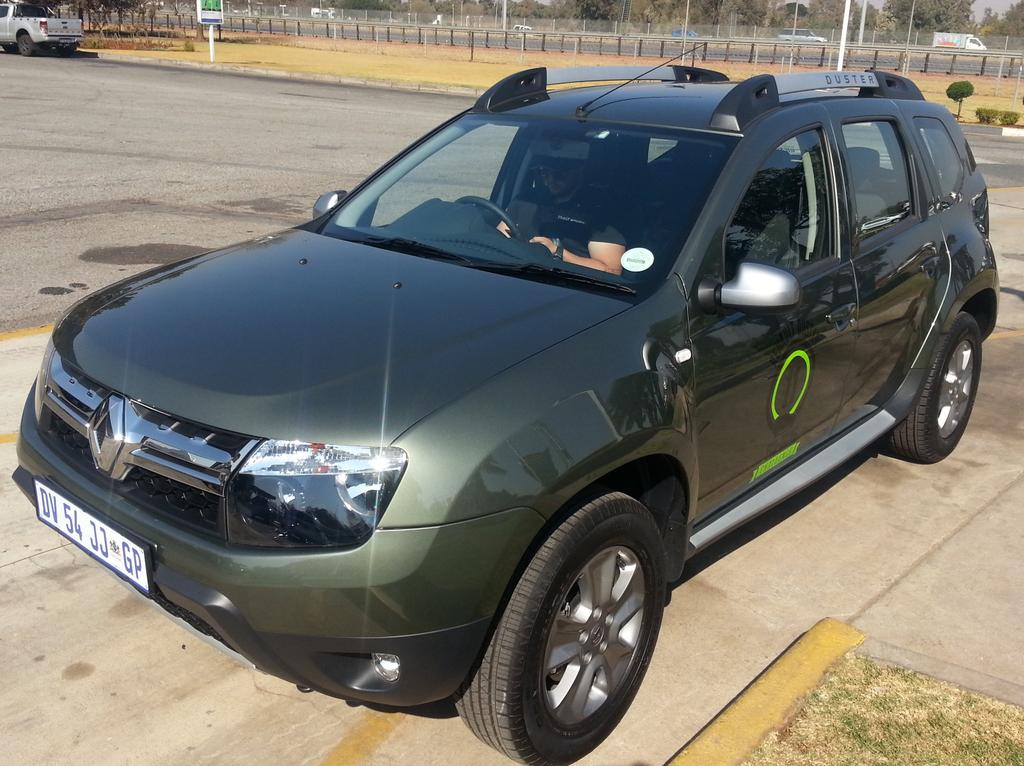
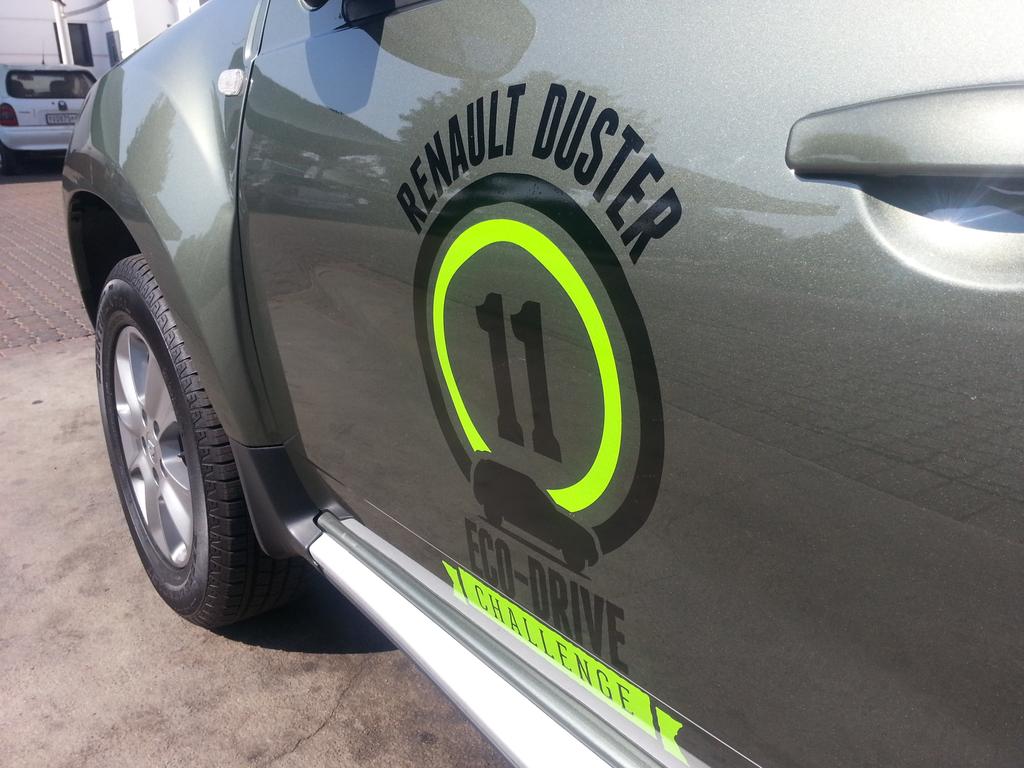
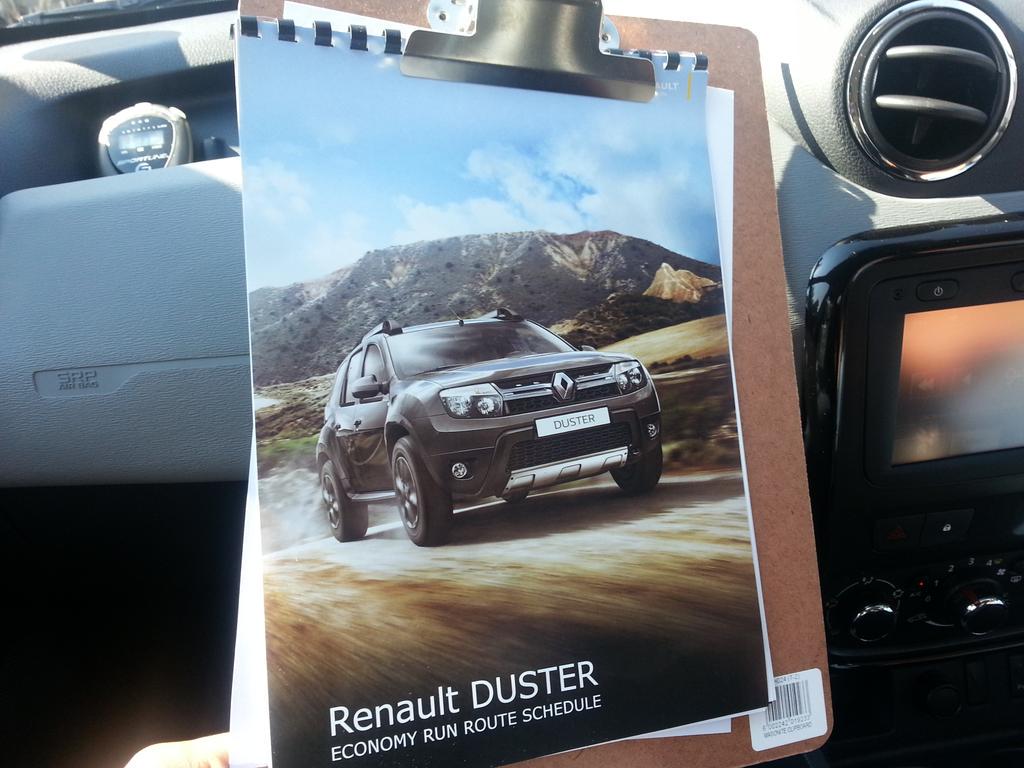
Sure the new diesel is refined with, Renault says, reduced consumption but can it walk the talk? Renault SA pitted journalists against each other in its Duster eco challenge (part time-trial, part economy run). In reality, it was more akin to a 300km off-road rally as we took on tar and dirt roads throughout Parys.
During the run I kept an eye on the fuel gauge throughout, while my navigator observed a stopwatch to make sure we reached our check points on time.
I achieved 4.8 litres/100km but due to time penalties was relegated to second place. The winner achieved 5.03 litres/100km without receiving a single penalty.  
Overall, an impressive improvement by Renault.
At moderate speeds on smooth surfaces, the ride is adequate and with the addition of slick cruise control for its entry-level units, road trips are made that much more pleasurable.
Renault maintains its Duster is quite adept as an off-roader in 4WD guise. It’s no Land Rover but considering its price and performance the Duster is accomplished off-road.
In terms of practicality it ticks all the right boxes for space and comfort with a spacious boot and plenty of head- and legroom.
ROMANIAN-BUILT FRENCH SUV
Production of the 2015 Duster has been moved from Chennai, India to Pitesti in Romania and is now manufactured at the same factory as its Sandero sibling.
Product manager at Renault SA Jeffrey Allison said: “Moving production to Pitesti provides us with the opportunity to refresh Duster within a sharper turnaround time - good for the brand and good for our customers here in SA.”
OVERALL
The Duster is a bargain compared to other SUVs with similar talents. It’s not perfect but if you’re looking for space and practicality, the Duster could be the car for you. If you're in need of a something more upmarket you could consider the Renault Captur.
The Renault Duster takes on the likes of Nissan Juke and Ford EcoSport in South Africa.
The Duster is sold with a five-year or 150 000km mechanical warranty, a three-year or 45 000km service plan (service intervals at 15 000km) and a six-year anti-corrosion warranty.
Test drive the Renault Duster at a Group 1 Renault dealership near you.
Article source: http://www.wheels24.co.za/Wheels4Women/CarCandy/New-Renault-Duster-in-SA-Revamped-revitalised-20150820

Tuesday, 28 November 2017

The New Megane Is Renault’s Latest Attack on the Golf

Renault is launching an all-new Mégane at the Frankfurt auto show. The bulbous, slightly overwrought four-door hatchback will be powered by fuel-efficient diesel and gasoline engines; Europe is likely to be the model’s biggest market.
The next Mégane will be the nameplate’s fourth model generation; the first one, designed in-house under Patrick Le Quément, was launched in 1995 as the successor of the Renault 19, which had replaced the Renault 11 (a.k.a. Renault Encore) in 1988.
While the Mégane comes to market as a four-door hatchback, it will soon be joined by a station-wagon version, as well as a low-slung two-door coupe. The proportions of the new models benefit from a new chassis with a far wider track, and the car is lower than its predecessor.
In the teaser release, Renault is touting the sporty GT model, but there is no doubt that the brand will ultimately launch a higher-performance Renault Sport version that should produce around 300 horsepower.
In global markets, the new Mégane competes with vehicles like the Ford Focus, the Opel Astra, the Peugeot 308, and the Volkswagen Golf. Will it come to the U.S.? Highly unlikely. But a lot of Renault parts are shared with Nissan, and we expect to see more technological overlap down the road.
The Mégane is available from a Group 1 Renault dealership. Test drive the Renault Megane and see why it’s the car for you!
Article source: https://blog.caranddriver.com/the-new-megane-is-renaults-latest-attack-on-the-golf/

2017 Renault Captur Goes Under The Knife, Gets New Face And Features


Having been on the market for four years, Renault decided to give the Captur small crossover a mid-cycle facelift.

On display at the brand's stand at the 2017 Geneva Motor Show, the small SUV comes with a new grille, inspired by the Kadjar, a chrome side strip, new skid plates on both bumpers, and fresh wheel patterns in 16- or 17-inches.

Three new body colors - Desert Orange, Ocean Blue and Amethyst, along with the new Mercury Silver option for the roof, and full-LED headlights on higher grades round up the list of exterior updates.

Inside, the facelifted Renault Captur is said to benefit from higher-quality plastics, chrome trim, more upmarket materials used on the steering wheel, or full-grain leather on certain versions, revised door panels and gear lever, LED roof light, and tweaked seats available on several variants.

For the first time, Renault added a new Signature S Nav/Initiale Paris trim level to the Captur, which features a metallic grey finish for the front and rear skid plates, around the windows and drip seals, and a specific range of colors.

The interior of the new addition brings heated Nappa leather seats, leather-trimmed steering wheel, and door panels, aluminum pedals, and aluminum door sills. Standard features include keyless entry and push-button start, Easy Park Assist, and Blind Spot Warning, and are complemented by the latest version of the R-Link infotainment, Android Auto, and premium Bose sound system.

Visit a Group 1 Renault dealership and take the Captur for a test drive. Speak to a Group 1 Renault consultant or view the full specs and prices of the Captur, online.

Story has been updated with photos from the Geneva show


Wednesday, 4 October 2017

2017 Renault Clio Update Revealed - Cosmetic Refresh, New Diesel

Renault has given its Clio small hatch range a modest refresh for the 2017 model year, with some minor tweaks to exterior styling that help modernise its appearance, but stop short of bringing it into line with Renault’s new breed of passenger cars.
Bumpers are new, with a wider lower grille at front and a new shape at the rear that Renault says sports “additional robustness”. The headlamps and tail lamps sport new internals and LED elements, though the Clio doesn’t receive the same “extended-C” daytime running lamp arrangement as the new Megane, Koleos or Talisman.

New wheel covers and alloy wheel designs round out the remainder of the external changes, and four new colours have been added to the Clio’s colour palette - Intense Red, Titanium Grey, Pearlescent White and Iron Blue.
Interior changes are minor, with the Clio retaining its dashboard layout virtually unchanged - though Renault says material quality has improved, with all-new cloth and leather upholstery too.

The silver interior trim is more subdued, with a matte rather than glossy finish. The texture of some cabin plastics has been improved as well to help impart a more premium feel to the Clio’s cabin. Three infotainment systems will be offered in Europe depending on specification, starting with a base “R&Go” system, a midgrade R-Link Evolution and Media Nav Evolution.
Under the bonnet changes are limited to the addition of a range-topping 80kW 1.5 litre diesel to the range, plus a six-speed manual transmission for the formerly auto-only 88kW TCe 120 petrol engine.
The diesel is highly unlikely to come here, though it remains to be seen whether Renault will equip locally-delivered Clios fitted with the TCe 120 engine - namely the automatic version of the Clio Expression, the Clio Dynamique and Clio GT/GT Premium - with the six-speed manual.
Check out the Renault Clio range at a Group 1 Renault dealership. Find a Renault Clio that suits you here and take it for a test drive.

Article source: http://www.themotorreport.com.au/63608/2017-renault-clio-update-revealed-cosmetic-refresh-new-diesel

Thursday, 3 August 2017

2016 Renault Trafic Review: Long-term report one

We get long-term loan vehicles of all shapes and sizes in the CarAdvice offices, and the 2016 Renault Trafic could be the biggest yet.
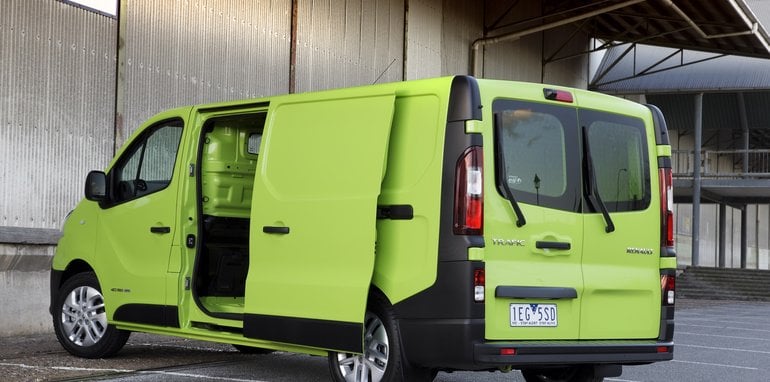
The Renault Trafic L1H1 we have here measures 4999 millimetres long, 1956mm wide, 1971mm tall and rides on a 3098mm wheelbase. That makes it a big bus, so it’s strange to think that there’s an even bigger Trafic – the L2H1 long-wheelbase model – that measures 5399mm from nose to tail, with a 3498mm wheelbase.
As you can probably tell from the dimensions (and the pictures), this mid-sized van from French brand Renault is essentially a box on wheels. And that’s the exact purpose for which we took delivery of this Trafic, which starts at $37,990 plus on-road costs.
This is the new Sydney camera crew van. It will be used primarily as a vehicle to transport all the gear required for shooting photos or videos out on the road for the reviews you see here on CarAdvice.
Now, a little about the Renault Trafic in a more general sense.
White vans, as they’re commonly referred to, are massively popular in Europe, and Renault leads the sales race on The Continent.
In fact, the previous-generation Trafic – which was often available for $30,000 or less – was the biggest-selling light commercial vehicle for the company and the third-best-selling vehicle in the range behind the Koleos SUV and Clio hatch.
But this new model hasn’t fared quite so well; while the majority of the Renault range has risen, the Trafic has dropped to seventh on the brand's sales ranks. Even the smaller Kangoo and larger Master vans yielded better sales than the Trafic in 2015.
Renault sold 1070 examples of the Trafic last year, down from 1643 the year prior. That was the old model, which was bolstered by fleet deals with the likes of Australia Post, and by the fact it came with a (semi-) automatic gearbox.
That's right: the Trafic – unlike most competitor vehicles in the segment – doesn't come with an auto ‘box. Instead, buyers have to deal with a six-speed manual transmission.
The Toyota HiAce smashes it in the sales race – it comes with petrol and diesel, manual and auto options – and while the Hyundai iLoad doesn’t have as extensive a range, it runs second by some margin. The recently released Volkswagen Transporter also has diesel drivetrain options aplenty.
For the Trafic there is the choice of two engines – the base model dCi90 single turbo diesel model has 66kW of power and 260Nm of torque, while the dCi140 model we’ve got has two turbochargers and 103kW/340Nm.
As we’ve found in the past, the fact the engine in the Trafic is a tiny 1.6-litre unit doesn’t mean it can’t haul a heavy load. This engine is a pearler, and thankfully the six-speed manual shift action is very user-friendly.
We’ve also praised the road manners of the Trafic in reviews past, so it will be intriguing to see how comfortable the members of the video team find it over the next few months. Oh, and with three seats, we’re sure there’ll be occasions where the front-seat comfort is tested in other ways.
Because it will be used on set, we asked for some accessories to be fitted to the van, including a roof rack ($1881 including fitting) with walking platform (adds $686, inc. fitting) and a steel ladder (a further $577, inc. fitting) to help the guys with the lenses get up to the top.
Further to those bits, our Trafic also has the Premium Pack ($2490), which consists of a number of convenience items to make motoring around in a van all the time.
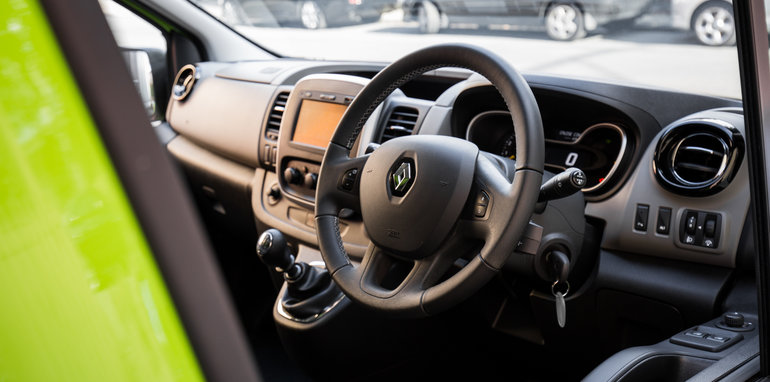
The goodies list includes a wide-view mirror (in the passenger’s-side sun visor) that gives a better view of what you can’t see to the side of you, as well as a 7.0-inch touchscreen with satellite-navigation, and a smartphone dock – which we’ve already found is too small for the iPhone 6S Plus or Samsung S6.
It also gets 17-inch alloy wheels, Java cloth seat trim, chrome and gloss black cabin trim highlights, and heated seats. Yeah, even van drivers get cold bums.
As part of a recent update, Renault added front-side airbags to complement the dual front airbags previously fitted as standard. We told them at the launch of the new model in May last year that side airbags should have been standard from the get-go, and we’re glad the message got across.
Further to that, all Trafic models have rear parking sensors, and both twin-turbo models – the short-wheelbase we have here and the long-wheelbase version – have a rear-view camera.
This is one aspect of the van that got the production team talking as soon as we got it in the garage. Without side glazed doors (which are available at extra cost), it is hard to see what’s coming when you’re reversing out of a driveway, but the high-mounted camera offers something of a wide-angle view of your surroundings. It isn’t as good as one of those clever rear cross-traffic alert systems you can get in some cars nowadays, but it’s a damn sight better than relying on hope and luck.
Stay tuned for more on the Renault Trafic over the coming months. We’re sure it’ll be present on set at a number of exciting content production shoots, and it might even get in front of the camera, too…